One of the questions I get most often from people visiting the food forest at Rancho de las Estrellas is: why these plants? In permaculture design, every plant is supposed to earn its place through multiple functions, not just one. A fruit tree that produces fruit, fixes nitrogen, provides shade for a lower layer, and drops leaves that become mulch is doing four or five things at once. That’s the design goal.
What follows is the working plant list for our food forest near Lagunas de Chacahua — not a comprehensive taxonomy, but a practical account of what’s actually in the ground, in a tropical subhumid climate on the Oaxacan Pacific coast, and why I chose it. Climate parameters matter here: a distinct wet season from May through October, a harsh dry season from November through April, consistent heat, and coastal humidity. Not everything that works in highland Oaxaca works here, and the selection reflects that.
Fruit trees: the canopy layer
The canopy is the structural foundation of the food forest — long-duration investments that take three to six years to reach meaningful production but anchor the system for decades.
Mango (Ataulfo and Manililla varieties)
Mango is the obvious choice for the canopy layer on the Oaxacan coast, and variety selection matters. I planted Ataulfo and Manililla specifically because they are locally adapted to this coastal climate — both are grafted varieties that produce earlier than seedlings and perform reliably in coastal heat. By the time a mango tree is mature in this system, it’s providing canopy shade for the layer below it, dropping leaves that become mulch, and producing fruit in volume.
Avocado (Hass and criollo varieties)
Avocado belongs in this system, though it struggled more with dry-season heat stress in year one than I expected. We’re using Hass alongside local criollo varieties selected over generations for this coastal environment — criollo tends to be more drought-tolerant once established and carries a flavor profile worth preserving. The lesson from year one: patience during establishment. These trees need a developed root system before they handle the dry season without intensive irrigation.
Tamarind and guanábana
Tamarind earns its place several times over: genuinely drought-tolerant once established, a culinary staple, useful wood, deep shade canopy, and a tree that lives long enough to outlast the people who planted it. Guanábana (soursop) is one of the most productive fruit trees in this climate and starts yielding earlier than mango or avocado. Both provide canopy shade for the planting below them.
Nance
Nance is native to the tropical dry forests of Pacific Mexico, which makes it a natural fit here. It’s drought-tolerant, produces small yellow fruits used locally in juices and fermented drinks, and its inclusion is partly about restoring what the ecology of this coast looked like before clearing. Native fruit-producing species belong in any honest food forest design for this region.
Nitrogen fixers: the soil workers
Nitrogen fixers are the plants most visitors overlook because they don’t produce anything edible directly. They are arguably the most important functional element in the first few years, when the soil biology is still building.
Leucaena leucocephala
Leucaena is the workhorse of tropical agroforestry for a reason: it grows faster than almost anything else in the system in year one, fixes atmospheric nitrogen, and produces biomass for chop-and-drop mulch around slower trees. The effect on soil moisture and organic matter in surrounding beds has been visible from the first season. One management note — leucaena can become invasive if not controlled. Regular cutting serves both the mulch function and prevents seeding out.
Gliricidia sepium
Gliricidia is native to Pacific Mexico. It’s used throughout the tropics as a living fence post — plant a cutting directly in the ground, it roots and grows, and you have a fence that also fixes nitrogen and produces mulch biomass. On the perimeter and between planting zones, Gliricidia handles boundary definition, wind buffering, nitrogen fixation, and biomass production simultaneously.
Pigeon pea (Cajanus cajan)
Pigeon pea is unique among the nitrogen fixers because it also produces food directly — the seeds are edible and eaten widely across the tropics. In our system it fixes nitrogen and provides harvests during the gap years while slower fruit trees mature. Fast-growing and reasonably drought-tolerant once established, it returns to the soil as organic matter after its productive life of three to four years.
Productive shrubs
Chaya (Cnidoscolus aconitifolius)
Chaya is the plant I recommend first to anyone designing a food system in tropical Mexico. It is almost indestructible in heat, it produces a nutritious leafy green that rivals spinach in protein and iron content, and it keeps producing through the dry season when many other greens shut down. The leaves need to be cooked — raw chaya contains mild toxins that break down with heat — but cooked it’s excellent and highly productive. A single mature chaya plant can be harvested repeatedly throughout the year.
Moringa (Moringa oleifera)
Moringa is one of the plants I’d describe as immediately useful rather than future investment. Leaves are already being harvested regularly, every part has documented nutritional or medicinal value, and its biomass feeds the soil around slower-growing trees. It’s a fast-establishing pioneer that earns its place from the first season.
Hibiscus (Jamaica)
Hibiscus does work that is partly functional and partly about the quality of the place. The calyces make agua de jamaica, which is consumed constantly at the Rancho. The flowers attract pollinators. Beauty in a food forest is not a trivial consideration — the more pleasant a place is to be, the more consistently it gets tended.
Ground cover and vines
Sweet potato and chayote
Sweet potato is the most effective ground cover I’ve found for bare tropical soil — it moves fast, suppresses weeds, retains moisture, and produces a food crop in the process. In the spaces between young trees it’s doing constant work protecting the soil surface from sun and heavy rain impact. Chayote climbs trellises and fence lines, produces prolifically in the wet season, and provides shade for plants below it as it goes.
Medicinal and functional plants
Lemongrass, aloe vera, epazote
Lemongrass in Zone 1, close to the living spaces, serves as a culinary and tea herb and as an insect repellent — the scent is effective against mosquitoes, which matters near the coastal wetlands. Aloe vera is entirely practical: sunburn, cuts, skin irritations from working outdoors in the tropics, aloe is the immediate response. Epazote is the essential herb of Oaxacan cooking — it flavors black beans, appears in moles and tamales, and has medicinal use as an antiparasitic. It self-seeds readily and asks almost nothing of you.
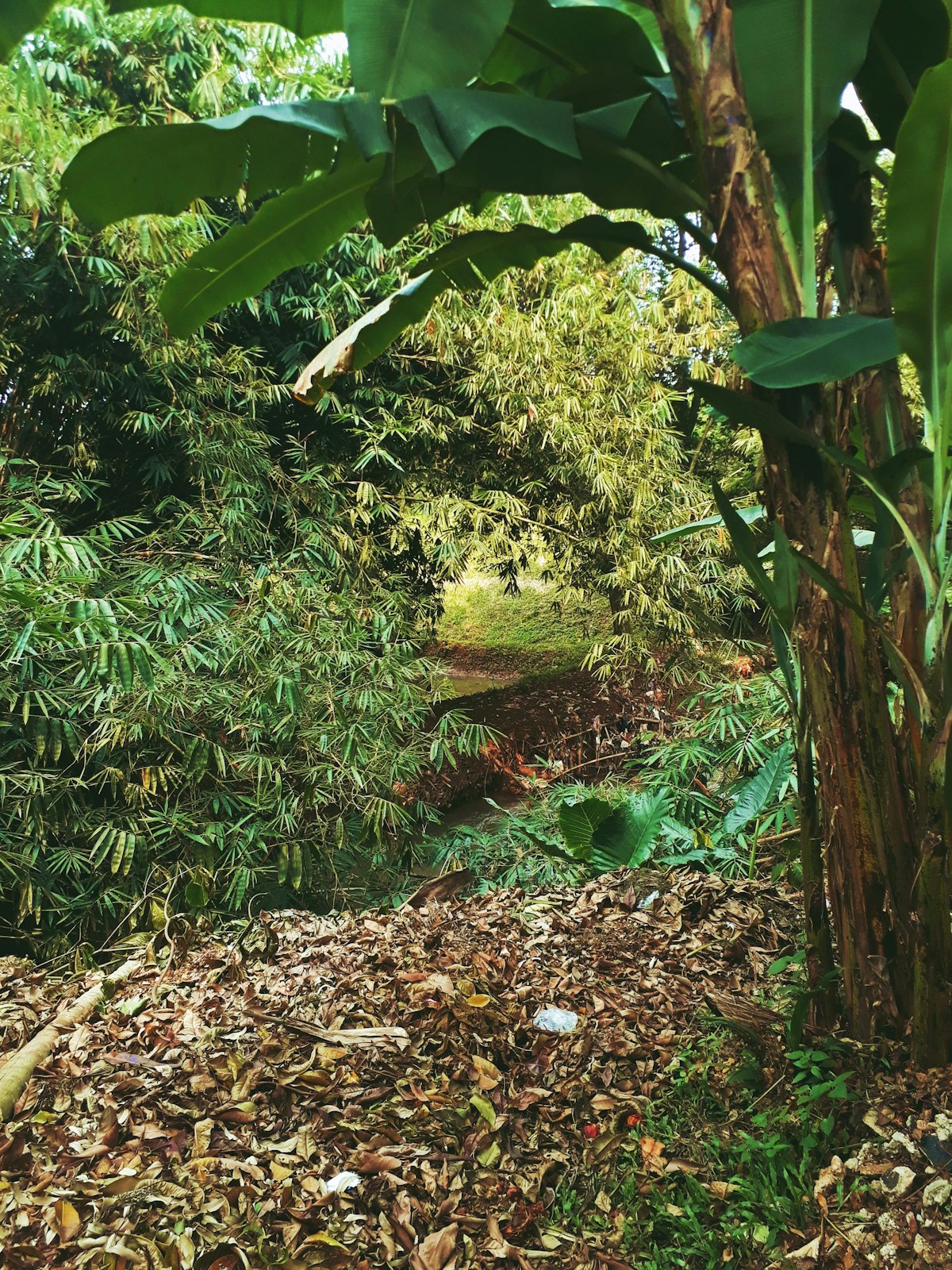
Native reforestation species
This layer matters to me as much as the food production layer, and it gets less attention in most food forest writing. The Zone 4 perimeter of our system is where we’re working to rebuild the native plant community that would have existed on this land before agricultural clearing.
Copal (Bursera species) is native to the Oaxacan dry forest and is one of the most ecologically and culturally significant trees in southern Mexico. The resin is burned in ceremonies throughout the region; the tree is a keystone species for the local insect community. We’re establishing copal seedlings at the perimeter.
Pochote, or kapok (Ceiba), is native to this coastal forest type and will eventually grow into a large canopy tree — we’re planting it with a decades-long horizon in mind. Native palms provide structural diversity and bird habitat, and we’re sourcing them from local nurseries and regional seed stock.
The native reforestation layer exists because food production is one purpose of this land, but ecological restoration is another. Rebuilding the native plant community creates habitat for birds and insects that support pollination and pest control across the whole system. A food forest embedded in a recovering native ecosystem is more resilient than one surrounded by bare soil or monoculture.
The plant list is a living document. Some of what’s here will change as we learn more about this land and this climate — year two and three will tell us things that year one couldn’t.
If you want to walk the food forest in person, the visit page has what you need. There’s a quality to seeing a food forest at ground level — the textures, the smell of the soil, the way the layers work together — that no description fully captures. If you’re thinking about being part of what we’re building here more permanently, the make it yours page lays out what that looks like.